
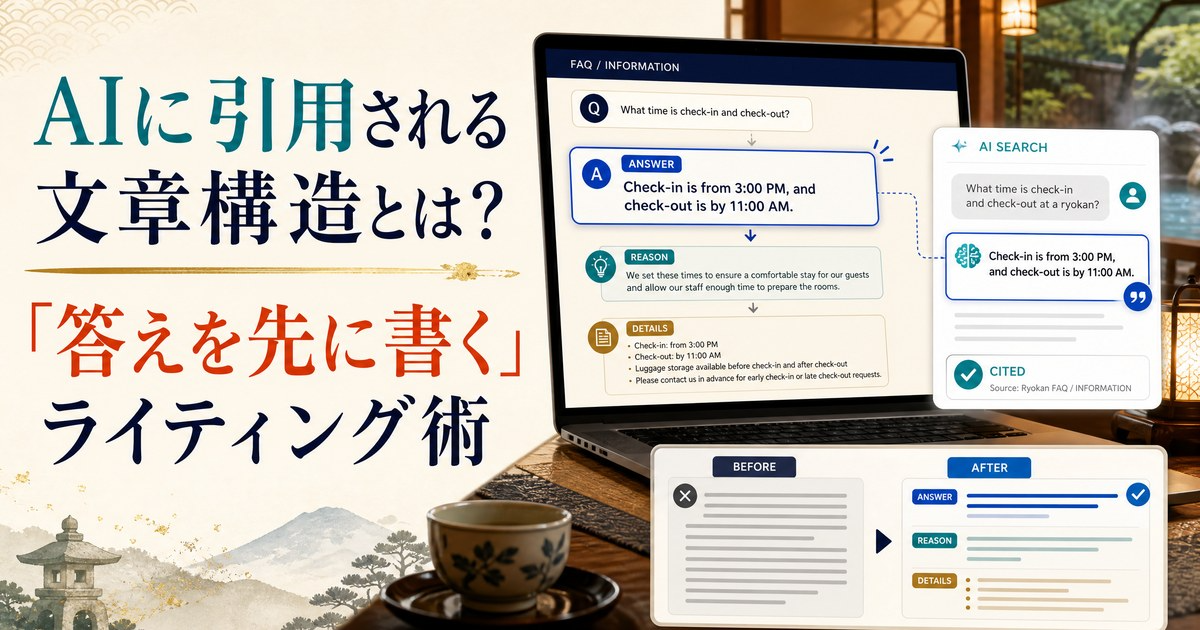
In our previous article, "What is AI Search (Answer Engine Optimization) and 3 Things Ryokans Can Do Right Now," we discussed the importance of writing FAQs in the 'Conclusion → Reason' format. This article will delve deeper into the specific writing technique known as 'Answer First' with actual text examples.
Why Does Text Structure Affect AI Quotation?
AI search engines extract answers to user questions from web content. Texts that provide a straightforward answer to the question are more easily recognized by AI as the definitive answer, making them more likely to be quoted or referenced. Conversely, texts that take a long time to reach the conclusion create a structure that is difficult for both AI and users to navigate when searching for necessary information.
What Does 'Answer First' Specifically Mean?
Using the structure of newspaper articles as an analogy can be helpful. Newspaper articles typically summarize the core information—'who,' 'what,' and 'when'—immediately after the headline, followed by detailed background and supplementary information. This structure of 'Conclusion → Reason/Supplement'—known as the inverted pyramid—can also be applied to the content of ryokan websites.
Before/After: Comparing Actual Texts
Example 1: Explanation About Parking
Before (Conclusion is Delayed): "Due to limited space on our premises and the surrounding road conditions, we have implemented various measures to secure parking spaces. However, we may not always be able to accommodate your requests, so we ask for your understanding in advance. We have parking available for 5 vehicles."
After (Conclusion is Presented First): "Yes, we have parking for 5 vehicles, available on a first-come, first-served basis. Please note that spaces may be limited during peak seasons, so we recommend contacting us in advance if you plan to drive."
The polite approach of starting with background information, as seen in the Japanese example, is natural in Japanese hospitality culture. However, it delays the crucial answer (that there are 5 parking spaces) for both AI and human readers.
Example 2: Explanation About Communal Bath Hours
Before: "To ensure you can relax fully, we adjust the hours of the communal bath according to the season and crowd levels. However, the following are the typical hours during regular periods."
After: "The communal bath is open from 3:00 PM to 11:00 PM. Hours may be adjusted seasonally, so please check with the front desk during your stay for the most current schedule."
Clarifying the Relationship Between Headings and Content
AI also uses the structure of the page (heading tags) as clues. By consistently using a format where the heading is in the form of a question followed by 1-2 sentences that provide the conclusion, it becomes easier for AI to identify which part constitutes the 'answer.'
Example: "### Is parking available?" "Yes, we have parking for 5 vehicles on a first-come, first-served basis." (Followed by additional details)
Structuring Sections in a Q&A Format
This approach should be applied not only to FAQ pages but also to pricing and access pages. By intentionally structuring expected questions as subheadings and providing conclusions immediately after, the entire site becomes easier for AI to navigate and find answers.
Balancing Japanese Politeness with Clarity
In Japanese hospitality culture, it is often considered polite to provide a detailed preamble or background explanation rather than stating the conclusion immediately. While it remains important to uphold this in Japanese content, it is beneficial to adopt a 'conclusion first' style in English content. This approach allows for a more effective distinction in writing styles based on language.
Practical Checklist
- Does the text provide a conclusion (Yes/No or specific answer) within 1-2 sentences immediately after the heading?
- Are background explanations or supplementary information provided after the conclusion?
- Is the heading phrased as an actual question that guests might ask?
- Is there a risk of cramming too many answers into a single section?
Conclusion: Answer First is Readable for Both AI and Humans
The principle of 'writing the answer first' is not only beneficial for being quoted by AI but also serves as a user-friendly writing style that allows busy travelers to quickly access the information they need. Start by reviewing your existing FAQ and access information pages with this perspective in mind.
At Studio HAKO, our HAKO Scan service offers a free assessment of your site's international readiness, including content structure. Begin by checking your current status.