
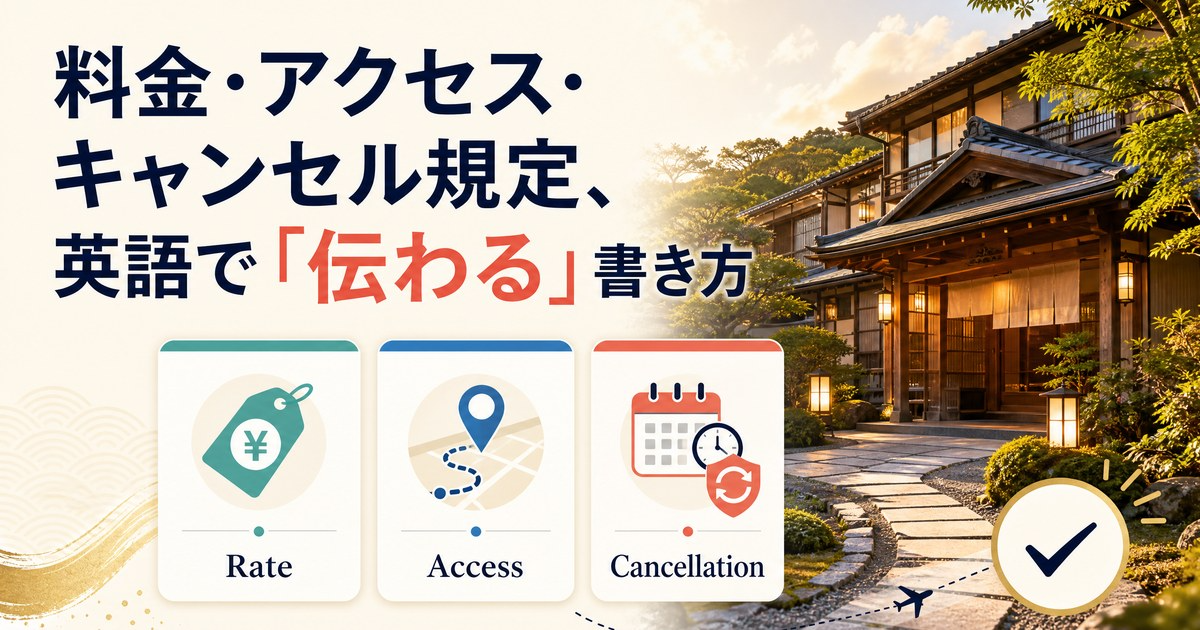
There are three crucial pieces of information that international guests always check right before making a reservation: rates, access, and cancellation policies. No matter how appealing your photos or room descriptions are, if these three pieces of information are unclear or hard to find in English, guests may feel uneasy and abandon their booking.
In this article, we will discuss how to present each of these details in a way that effectively communicates the necessary information in English.
Why Are These Three Pieces of Information Especially Important?
Rates, access, and cancellation policies are directly related to factors that travelers want to avoid failing at: money, time, and the risk of changes in plans. While Japanese guests often confirm details via phone, international guests face a higher barrier due to language differences. Information that is not clearly stated on the website is often treated as if it does not exist. Therefore, the completeness of these three pages can significantly impact your booking rates.
Rates: Clearly Specify What Is Included and What Is Not
One of the most common pitfalls in rate presentation is using vague phrases like "from ¥25,000 for one night with two meals included." International guests may not be familiar with the structure of accommodation pricing in Japan, so it’s essential to clearly outline the following:
- What is included in the displayed rate (meals, taxes, service charges, etc.)
- What is not included in the displayed rate (bath tax, additional meal options, etc.)
- Variations in pricing based on the number of guests (different rates for single vs. double occupancy)
- Payment methods (whether credit cards are accepted, if payment is made on-site or in advance)
For example, stating "Rate includes dinner, breakfast, and hot spring tax. Credit cards are accepted at check-in." helps to prevent misunderstandings by summarizing inclusions and payment methods in one sentence.
Access: Write with Travelers Who Are Unfamiliar with the Area in Mind
Japanese access guides often provide concise information like "10 minutes on foot from XX Station," but this may not be sufficient for international guests. Supplement your access information with details that consider guests unfamiliar with Japan's transportation system:
- Specific transportation options (train, bus, taxi) and estimated travel times from the nearest major station or airport
- Availability of shuttle services and how to book them
- Ease of movement with large luggage (availability of stairs, location of coin lockers, etc.)
- A link to Google Maps (ensuring the address is in English and can be searched directly in map applications)
Instead of just stating, "10 minutes by taxi from the station," you could say, "A taxi from the station takes about 10 minutes and costs approximately ¥1,500," providing a clearer sense of reassurance.
Cancellation Policies: Eliminate Ambiguity
Cancellation policies are one of the most critical elements that can lead to disputes. While a Japanese phrase like "Free cancellation until the day before, 50% charge for same-day cancellations" may suffice in Japanese, it’s important to clarify the reference time (what time) and time zone in English.
- Clearly specify when cancellation fees apply (days and times)
- Outline the refund process and the estimated time for refunds
- State your policy regarding force majeure events like bad weather or disasters
- Distinguish clearly between changes (date changes) and cancellations
For example, writing "Free cancellation until 3:00 PM (Japan time), 3 days before check-in" helps prevent misunderstandings due to time zone differences.
Common Mistakes
- Cancellation policies are only available in Japanese, with no links on the English page
- Ending with "For details, please contact us" without providing specific conditions in English
- Relying on translation tools for rates and cancellation figures without checking units or date formats (which may differ between Japan and other countries)
Checklist: Use This Page Right Away
- Are inclusions and exclusions in the rates clearly stated?
- Is the payment method (credit card acceptance) mentioned?
- Are there specific transportation options and estimated travel times from the nearest station or airport?
- Is there a link to Google Maps?
- Are the specific dates and times when cancellation fees apply clearly stated?
- Is the time zone (Japan time) clearly indicated?
Conclusion: Prioritize Reviewing These Three Pages
While reviewing your entire English website can be overwhelming, focusing on the pages for rates, access, and cancellation policies is worthwhile as they directly relate to last-minute drop-offs in bookings. Before adding more attractive photos or content, first ensure that the information on these three pages is clear and comprehensive.
Studio HAKO's HAKO Scan offers a free assessment of your site's international readiness, including factors that may lead to last-minute drop-offs. Start by checking your current status.