
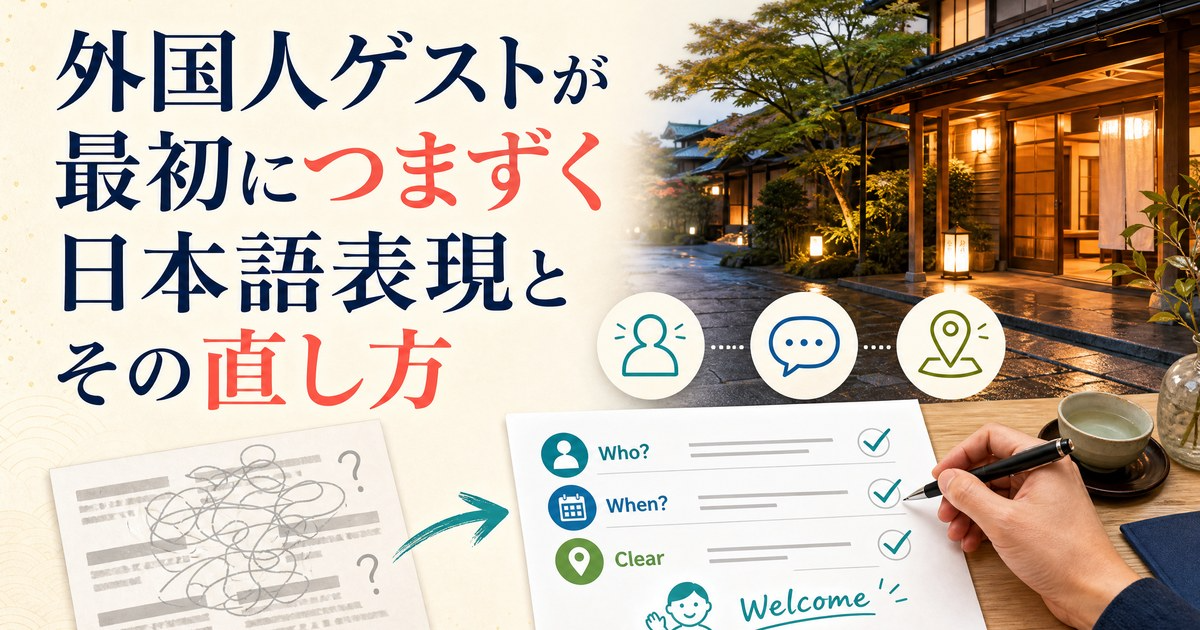
When it comes to improving English websites, the focus often shifts to the quality of translations and checking English text. However, the root of confusion can often lie in the original Japanese text itself, prior to translation.
Even if the Japanese text is natural, polite, and beautifully written, it may still be "difficult to translate". No matter how skilled the translator or translation tool, the meaning can become ambiguous or the intended nuance can be lost in English. In this article, we will explore common "stumbling blocks" found in Japanese text on ryokan websites and how to revise them for easier translation.
Stumbling Block 1: Omitted Subjects
Japanese sentences can stand without explicitly stating the subject. For example, the phrase "We will guide you to your room after your arrival" is natural in Japanese, but when translated directly into English, it can become unclear who is providing the guidance.
How to Fix It: Before translating, rewrite the sentence to include the subject, such as "Our staff will guide you to your room after your arrival." This significantly improves translation accuracy.
Stumbling Block 2: Ambiguous Euphemisms and Refusals
In Japanese, it is common to avoid direct refusals by using euphemisms like "It might be difficult" or "We will consider it." While native speakers understand these phrases as implicit refusals, translating them directly into English can lead to misunderstandings, suggesting that there is still a possibility.
How to Fix It: Clarify the actual situation in the Japanese text before translating. Instead of saying "It might be difficult," use a more definitive statement like "We generally cannot accommodate this request (please consult us individually if there are exceptions)." This makes the conclusion clear before translation.
Stumbling Block 3: Sensory and Onomatopoeic Expressions
Expressions unique to Japanese, such as "refreshing hot springs," "a comforting moment," or "a charming atmosphere," can be difficult to convey in English when translated literally.
How to Fix It: Instead of attempting to translate sensory expressions directly, replace them with specific reasons for those feelings. For instance, instead of saying "refreshing hot springs," provide details about the water quality (like sulfur springs), temperature, or benefits, ensuring that the meaning remains clear after translation.
Stumbling Block 4: Multiple Pieces of Information in One Sentence
Japanese sentences, especially in formal contexts, tend to be lengthy and packed with information. A sentence like "Check-in starts at 3 PM, but we can hold your luggage if you arrive earlier, so please contact the front desk" contains too much information, making it difficult to read in English.
How to Fix It: Break down the information into separate sentences before translating. For example, say "Check-in starts at 3 PM." "We can hold your luggage in advance." "Please contact the front desk if you arrive early." This results in clear and concise English translations.
Stumbling Block 5: Cultural References Without Explanation
Standard expressions rooted in Japanese hospitality culture, such as "We are sincerely looking forward to your visit" or "Please take your time and enjoy your stay," can be difficult for Western travelers to understand when translated literally, sometimes coming off as exaggerated.
How to Fix It: Not everything needs to be translated literally. Shift to expressions that convey the same sentiment in a way that feels natural in English-speaking contexts (e.g., "We look forward to welcoming you" or "We hope you enjoy your stay").
Three Basic Rules for Writing Easily Translatable Japanese
A common theme among the above patterns is that "natural Japanese does not always equal easily translatable Japanese." When writing the Japanese text that will serve as the basis for English pages, keep the following in mind:
- Do not omit subjects or objects; clarify who does what.
- Keep sentences short and include only one piece of information per sentence.
- Replace sensory or metaphorical expressions with concrete facts or reasons.
Conclusion: Review Your Japanese Before Translation
To enhance the quality of your English website, it is just as important to review the writing of the original Japanese text as it is to focus on the translation process itself. Particularly if you are planning to create new English pages or improve existing ones, start by refining the Japanese text into "easily translatable Japanese" before requesting translations.
Studio HAKO's HAKO Scan offers a free diagnostic of your site's international readiness, including content-related challenges for English pages. Begin by assessing your current situation.