
Understanding the overall inbound demand through data is crucial for ensuring that your company's customer acquisition strategies are on target. This article organizes the inbound trends for 2026 and insights for the accommodation industry based on the latest visitor data released by the Japan National Tourism Organization (JNTO).
Record Highs in 2025
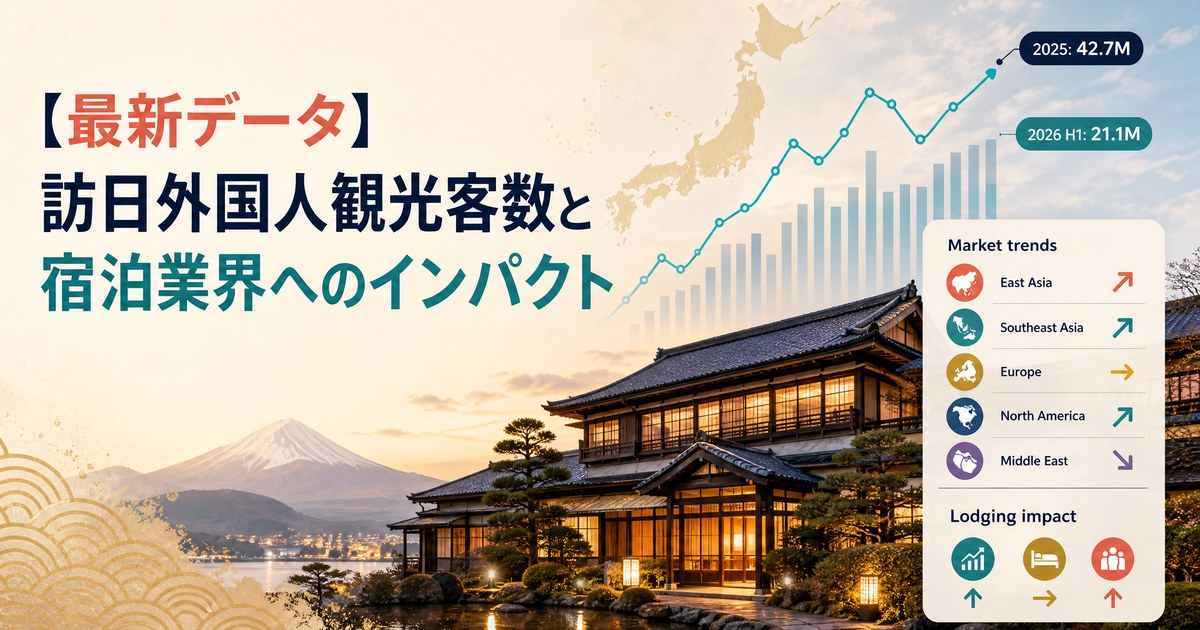
According to JNTO, the number of foreign visitors to Japan in 2025 reached 42,683,600, marking a 15.8% increase from the previous year and setting a new record. The continued trend of a weaker yen contributed to this figure, surpassing the previous year (2024) by over 5.8 million visitors.
First Half of 2026: Over 20 Million for Two Consecutive Years, but Slight Decline
In the first half of 2026 (January to June), the total number of foreign visitors was 21,084,800. Although this represents a 2.0% decrease compared to the same period last year (21,518,575), it still maintains a high level of over 20 million for the second consecutive year. Overall, it indicates that strong inbound demand continues.
Monthly Trends: Significant Variability in Demand
Examining the monthly trends reveals that inbound demand in 2026 is not uniform, with significant fluctuations in year-on-year changes.
- March: 3,618,900 visitors (3.5% increase year-on-year, the highest for March). The cumulative total for January to March was 10,683,500, surpassing 10 million for two consecutive years.
- April: 3,692,200 visitors (5.5% decrease year-on-year, yet the highest for April in 2026). The cumulative total for April remained above 14 million for two consecutive years.
- May: 3,559,900 visitors (3.6% decrease year-on-year, marking two consecutive months of decline).
- June: 3,148,600 visitors (6.8% decrease year-on-year, continuing the trend of decline for three consecutive months).
- July: 3,442,100 visitors (0.1% increase year-on-year, surpassing the previous year's figures for the first time in four months, setting a record for July).
While monthly figures continue to set records, year-on-year changes show fluctuations, indicating that demand does not follow a simple upward trend but varies month by month.
Changes in Market Dynamics
A particularly notable trend in the number of foreign visitors to Japan in 2026 is the divergence among markets.
Significant Decline in the Chinese Market
The number of visitors from China has seen a substantial decline throughout 2026, with decreases of 50-60% year-on-year. According to JNTO, this is likely due to travel advisories from the Chinese government regarding travel to Japan and reductions in flight availability. This decline could significantly impact accommodation facilities that heavily relied on the Chinese market.
Strong Performance from South Korea and Taiwan
Conversely, the number of visitors from South Korea and Taiwan has shown strong performance, exceeding last year's figures or setting new records in many months. For instance, in July, the number of visitors from Taiwan surpassed 700,000 for the first time in a single month, marking a record high.
Growth in Southeast Asia, Europe, North America, and the Middle East
In addition to the major markets of South Korea, Taiwan, and China, there has been growth in visitor numbers from Southeast Asia, Europe, North America, and the Middle East, with many months recording new highs. JNTO is also enhancing its appeal to the U.S. market by promoting Japan as a wellness tourism destination, among other initiatives targeting diverse markets.
Implications for the Accommodation Industry
Dependency on Specific Markets Poses Risks
As demonstrated by the significant decline in the Chinese market, heavy reliance on specific countries or regions for customer acquisition can lead to substantial risks if market conditions change. It is crucial to engage in information dissemination across multiple markets (primarily in English, while considering other languages as needed) to mitigate these risks.
Opportunities in Growing Markets
In addition to South Korea and Taiwan, there are numerous growing markets, including Southeast Asia, Europe, North America, and the Middle East. It is worthwhile to assess which markets your accommodation facility is attracting guests from, reviewing feedback and OTA data, and considering strategies to appeal to these growing markets (such as language support, payment options, and cultural considerations).
Adapting Operations to Demand Fluctuations
As indicated by the monthly figures, inbound demand is not constant. As discussed in a previous article, "Adapting Site Operations to Changes in Inbound Demand," establishing a flexible operational framework that anticipates change is essential for long-term stable management.
Conclusion: Monitor Data and Reflect on Strategy
While the overall inbound market remains at a high level, the breakdown by market shows significant ongoing changes. Regularly checking the data released monthly by JNTO and comparing it with your customer acquisition status is a valuable habit that can be incorporated into the monthly improvement cycle discussed in "The Monthly Improvement Cycle in International Marketing."
With Studio HAKO's HAKO Scan, you can receive a free assessment of your website's international responsiveness based on these market trends. Start by checking your current status today.
→ Try HAKO Scan for Free → View Our Services
Source: Estimates of foreign visitor numbers to Japan released by the Japan National Tourism Organization (JNTO) for 2025 and 2026.