
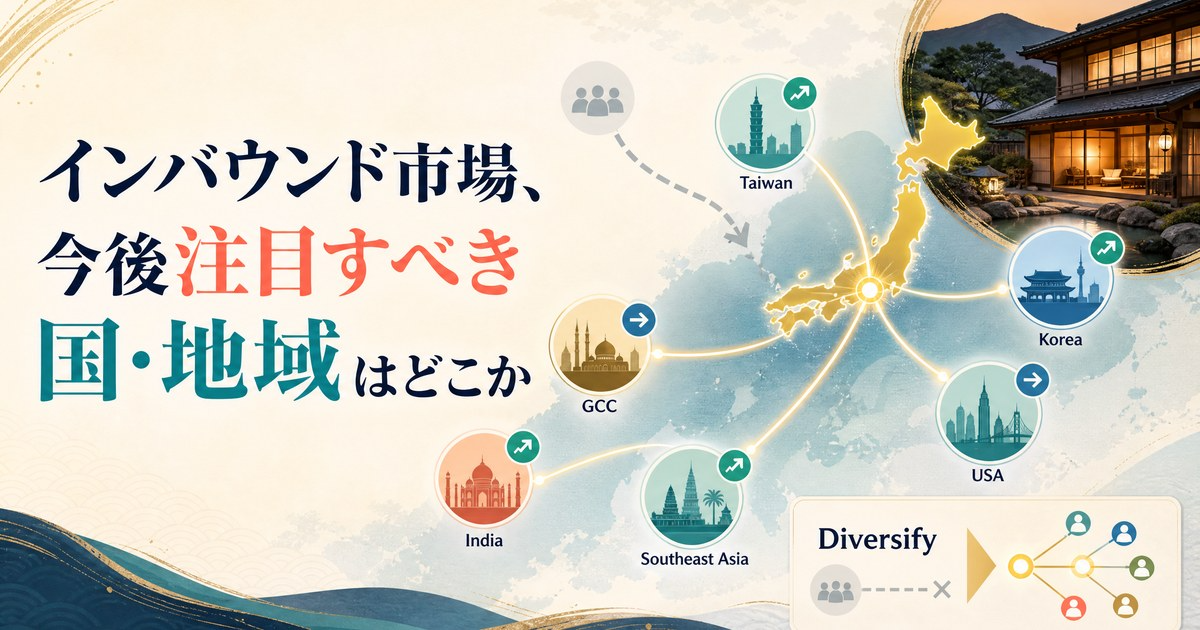
As mentioned in our previous article, "Latest Data: The Impact of Inbound Foreign Tourists on the Accommodation Industry," the inbound market in 2026 is expected to see a significant decrease in visitors from China, while several other markets are poised for robust growth. This article delves into specific countries and regions that should be prioritized in future customer attraction strategies, supported by concrete data.
Taiwan: A Market with Stable High Growth
The number of visitors from Taiwan is projected to exceed last year's figures significantly for many months throughout 2026, with July marking a record high of over 700,000 visitors in a single month. Due to its geographical proximity and a high number of repeat visitors, this market is expected to maintain a consistently high level of demand.
South Korea: Maintaining a Top-Class Scale
South Korea continues to hold the top position for inbound visitors for many months, with some months showing an impressive year-on-year increase of 20-30%. Given its proximity and convenience, it remains a vital market for the accommodation industry.
Middle East (GCC Countries): A High-Value Market Often Called the "Last Blue Ocean"
The number of visitors from GCC countries, including the United Arab Emirates and Saudi Arabia, is expected to reach 44,700 in 2024 (a 34.6% increase year-on-year), with a total of 166,300 visitors from eight Middle Eastern countries, including Turkey (a 51.8% increase year-on-year) (according to JNTO and JETRO). This market is gaining attention as it is described in industry seminars as "largely untapped for Japan yet one of the world's premier high-value travel markets." In 2026, monthly data from JNTO shows that the Middle East region is also expected to record its highest number of visitors in a single month.
However, due to escalating tensions in the Middle East, Oxford Economics has significantly revised its travel demand growth forecast for the region downward for 2026, indicating some short-term uncertainty. While the long-term potential remains high, it is essential to remain vigilant regarding changes in the situation.
India: An Emerging Market Recording Record Highs
Data from JNTO for 2026 shows that India has recorded its highest number of visitors in several months, steadily increasing its presence in the market. With a large population and an expanding middle class, India is viewed as a market with promising medium- to long-term growth.
Southeast Asia: Steady Growth Across Multiple Markets
Countries in Southeast Asia, such as Vietnam and Indonesia, have also seen record highs in visitor numbers month after month, indicating robust overall growth. The geographical proximity and economic growth are expected to continue driving travel demand in the future.
United States: New Appeal as a Wellness Tourism Destination
The U.S. market is showing steady growth, and JNTO is enhancing its efforts to promote Japan as a "wellness destination" to American travelers. For ryokans and accommodation facilities with traditional healing cultures, this trend toward wellness can serve as a significant advantage.
China: Continued Uncertainty
Conversely, the number of visitors from China, which has been a major pillar of inbound tourism, is expected to decrease significantly by 50-60% year-on-year throughout 2026. Travel advisories and reduced flight availability are impacting this market, leading to an unclear outlook for short-term recovery. For accommodation facilities heavily reliant on the Chinese market, diversifying into other markets has become a crucial business challenge.
Practical Insights for the Accommodation Industry
Avoid Trying to Cater to All Markets Simultaneously
While there are several promising markets, it is unrealistic to address all languages and cultures with limited resources. Start with English as a base and identify markets that align well with your location and concept (e.g., wellness-focused ryokans targeting the U.S. wellness sector or traditional cultural experiences appealing to affluent customers in the Middle East). Prioritizing these markets is a more practical approach.
Avoid Dependency on Specific Markets
The sharp decline in the Chinese market illustrates the risks associated with relying heavily on a specific country or region for customer attraction. It is advisable to aim for a balanced approach to attracting visitors from multiple markets as a long-term goal.
Continuously Monitor Changes in the Situation
As seen with the situation in the Middle East, even promising markets can experience significant fluctuations in short-term demand due to international circumstances. The operational framework discussed in "Adapting Site Operations to Changes in Inbound Demand" is equally important when selecting markets.
Conclusion: A Flexible Customer Attraction Strategy Focused on Multiple Markets
The markets to watch in the future are not limited to one; there are diverse options such as stable markets like Taiwan and South Korea, growth markets like the Middle East and India, and steadily expanding markets in Southeast Asia and the U.S. It is crucial to adopt a flexible approach while identifying markets that align with your strengths, avoiding over-reliance on specific markets as you strategize for inbound customer attraction.
At Studio HAKO, our HAKO Scan service offers a free assessment of your website's international responsiveness based on these market trends. Start by checking your current status today.
→ Try HAKO Scan for Free → View Our Services
Source: Japan National Tourism Organization (JNTO) estimates of inbound visitor numbers, JNTO and JETRO data related to GCC countries, Oxford Economics travel market forecasts (2026)