
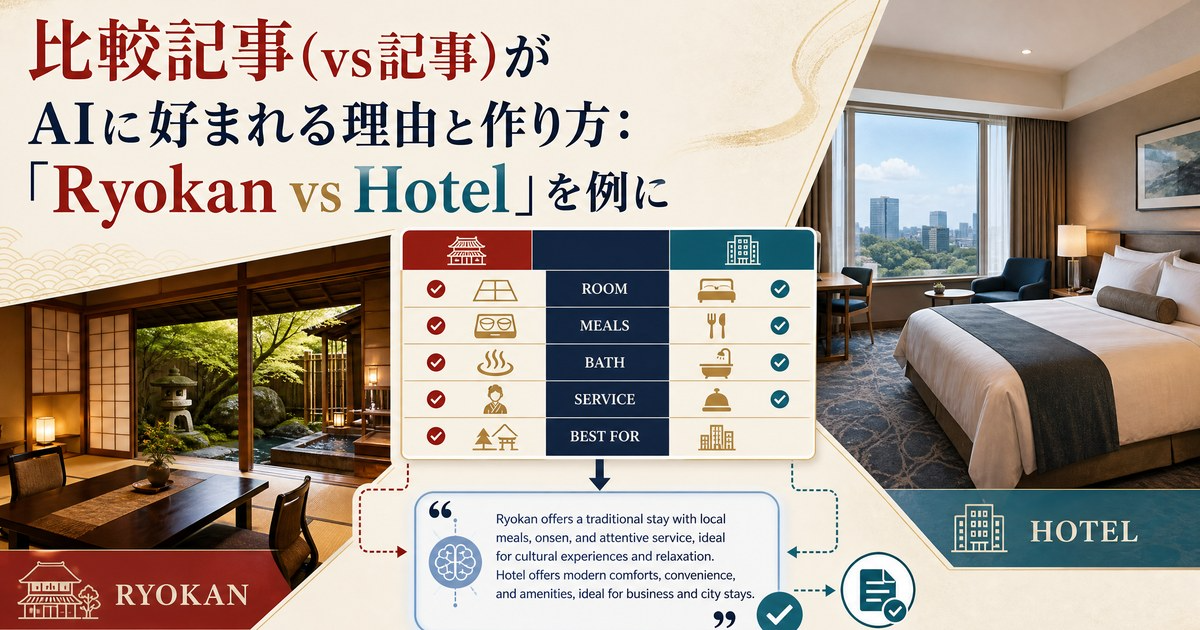
'Should I stay at a ryokan or a hotel?' — This is a common question posed by international travelers planning a trip to Japan. In this article, we will explore why comparison articles, like 'Ryokan vs Hotel', are favored by AI search engines and how to create them effectively.
Why Comparison Articles Are Favored by AI
A study analyzing the citation trends of AI search engines found that comparison tables containing extractable data are a key feature of content that is frequently cited. This aligns with the inherent characteristics of comparison articles.
Firstly, questions framed as 'Which is better, A or B?' are a very common pattern in AI searches. Due to their nature, comparison articles often present information in tables or bullet points, making it easier for AI to extract and summarize differences between items. Alongside the definition pages discussed in 'Why Creating a Glossary Page is Beneficial', comparison articles are also a content format that works well in the AI search era.
How to Create a 'Ryokan vs Hotel' Article
1. Prepare a Comparison Table
Start by clearly defining the items to compare and organize them in a table format. Here’s a simple example of a comparison table:
| Feature | Ryokan | Hotel |
|---|---|---|
| Rooms | Primarily tatami-floored Japanese-style rooms with futons | Mainly Western-style rooms with beds |
| Meals | Often served in-room or in private dining rooms, featuring kaiseki cuisine | Typically buffet or à la carte in restaurants |
| Bathing Facilities | Focus on communal baths and hot springs, with a culture of shared bathing | Usually private bathrooms in guest rooms |
| Staff Interaction | Personalized service from staff like nakai and okami | Often self-service with less direct interaction |
| Recommended for | Those wanting to deeply experience Japanese culture | Those prioritizing efficiency and privacy |
2. Present the Conclusion Upfront
Similar to the principles discussed in 'What Writing Structure is Cited by AI? Writing with the Answer First', it’s important to present a concise conclusion at the beginning of comparison articles.
Example: "Ryokans offer an immersive cultural experience with tatami rooms, communal baths, and traditional meals, while hotels prioritize privacy, convenience, and Western-style amenities. Travelers seeking authenticity often prefer ryokans, while those prioritizing efficiency may prefer hotels."
3. Maintain a Neutral Tone
In comparison articles, it’s crucial to convey the characteristics of both options from a fair perspective rather than solely promoting your own (ryokan). Acknowledging the conveniences of hotels while highlighting the unique value of ryokans will make the information more trustworthy for both readers and AI.
Other Comparison Article Ideas
- Ryokan vs Minshuku (Differences between ryokans and guesthouses)
- Onsen Ryokan vs City Hotel (Differences between hot spring ryokans and urban hotels)
- Private Onsen vs Communal Bath (Differences between private baths and public baths)
- Traditional Kaiseki vs Buffet Breakfast (Differences between kaiseki cuisine and buffet meals)
These topics provide valuable information for travelers still exploring Japan's accommodation styles and are also likely to be cited in AI searches.
Important Note: Avoid Bias and Stick to Facts
While comparison articles are a great opportunity to showcase your strengths, overly biased content can undermine credibility. Strive for a balanced narrative that recognizes the merits of hotels while conveying the experiential value unique to ryokans.
Conclusion: The Value of Comparison Perspectives for AI Searches and Readers
Comparison articles not only possess a structure that is favorable for AI search engines but also provide valuable insights for travelers unfamiliar with Japanese accommodation culture. Starting with 'Ryokan vs Hotel', we encourage you to create comparison articles on themes related to your own establishment.
Studio HAKO's HAKO Scan offers a free assessment of your website's international readiness, including content strategies. Start by checking your current status today.