
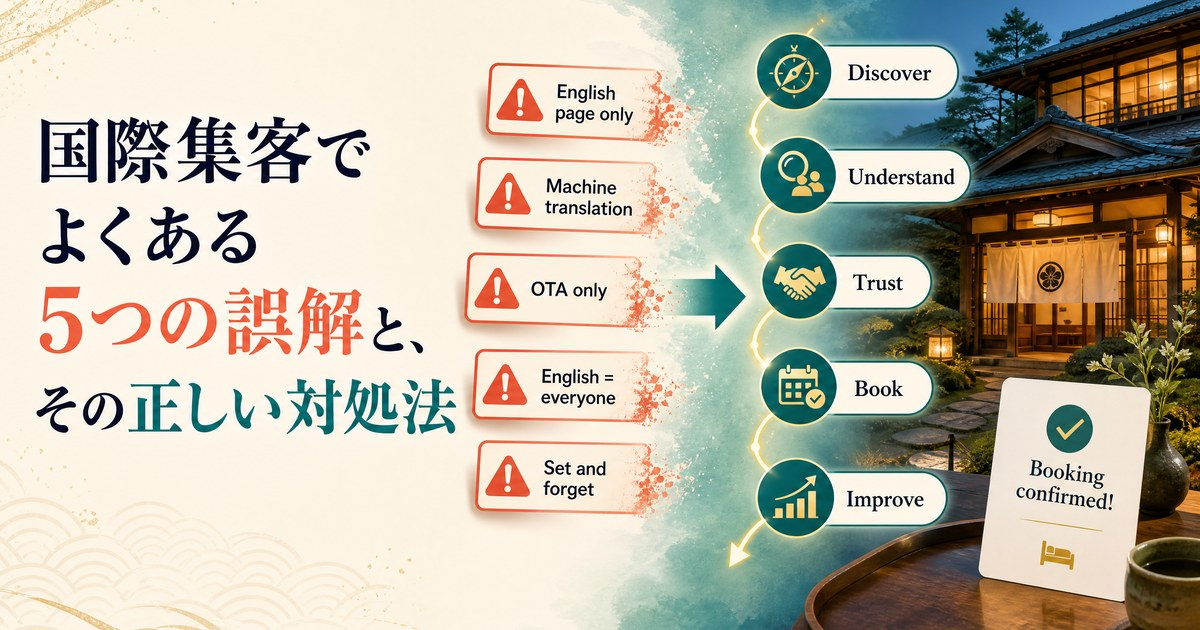
Despite a serious commitment to international customer acquisition, many find that results are not as expected. Often, the issue is not a lack of effort but rather responses based on common misconceptions. In this article, we will revisit topics covered in previous blog posts and clarify five common misunderstandings in international customer acquisition along with the correct approaches to each.
Misconception 1: "Having an English page is enough"
One of the most prevalent misconceptions is treating the creation of an English page as the end goal. In reality, even if you have an English page, if the structure is not set up correctly for search engines (such as hreflang tags), it won't be found. If the content is lacking, it won't be trusted, and if the booking process is not streamlined, potential customers will leave.
Correct Approach: Instead of focusing solely on whether you have an English page, ensure that the entire experience—from discovery to understanding, trust, and booking—is well-structured. For more details on this structural issue, refer to our article on why overseas customers can't find you.
Misconception 2: "Machine translation is sufficient"
Many businesses opt to publish machine translations without further review due to cost and effort considerations. However, machine translations often fail to accurately convey nuances specific to Japanese hospitality culture, leading to misunderstandings and potential issues.
Correct Approach: Use machine translation as a starting point, but always have important information (like pricing and cancellation policies) checked by a human. Our article on the pitfalls of relying solely on machine translation highlights specific issues to watch out for.
Misconception 3: "If I'm listed on OTAs, I don't need my own website"
Some believe that simply being listed on OTAs like Booking.com or Agoda is enough. However, reservations made through OTAs incur ongoing fees that can impact profitability. Additionally, if your website is weak in search results, you may miss opportunities to build trust with potential customers who show interest.
Correct Approach: Utilize OTAs as an entry point for discovery while strengthening your own website as a place for trust and decision-making. A dual strategy is essential, as discussed in our article on how to strengthen both OTA and your own site's SEO.
Misconception 4: "Foreign guests = English-speaking guests"
Another common misconception is assuming that providing English support means you can cater to all international guests. In reality, many visitors come from non-English-speaking countries such as Taiwan, South Korea, the Middle East, and India, each with unique priorities and cultural backgrounds.
Correct Approach: While English support is fundamental, identify the primary countries or regions of your target audience and incorporate specific considerations as needed. For insights on emerging inbound markets, check out our article on which countries and regions to watch.
Misconception 5: "Once it's created, it's done"
After setting up a website, many fall into the trap of leaving it unattended. Search engine algorithms and inbound demand are constantly changing, and what was optimal at launch may lose competitiveness over time.
Correct Approach: Regularly review search rankings, exit pages, customer reviews, and inquiry content to establish a system for ongoing improvement. Our article on the monthly improvement cycle in international marketing provides specific operational methods.
Conclusion: Recognizing Misconceptions is the First Step to Improvement
What these misconceptions have in common is that they all seem plausible at first glance. This is why many businesses unknowingly fall into the same traps. Take a moment to reflect on whether your efforts align with any of these five misconceptions.
At Studio HAKO, our HAKO Scan service can provide a free diagnosis of your website's international readiness, including issues based on these misconceptions. Start by assessing your current situation.