
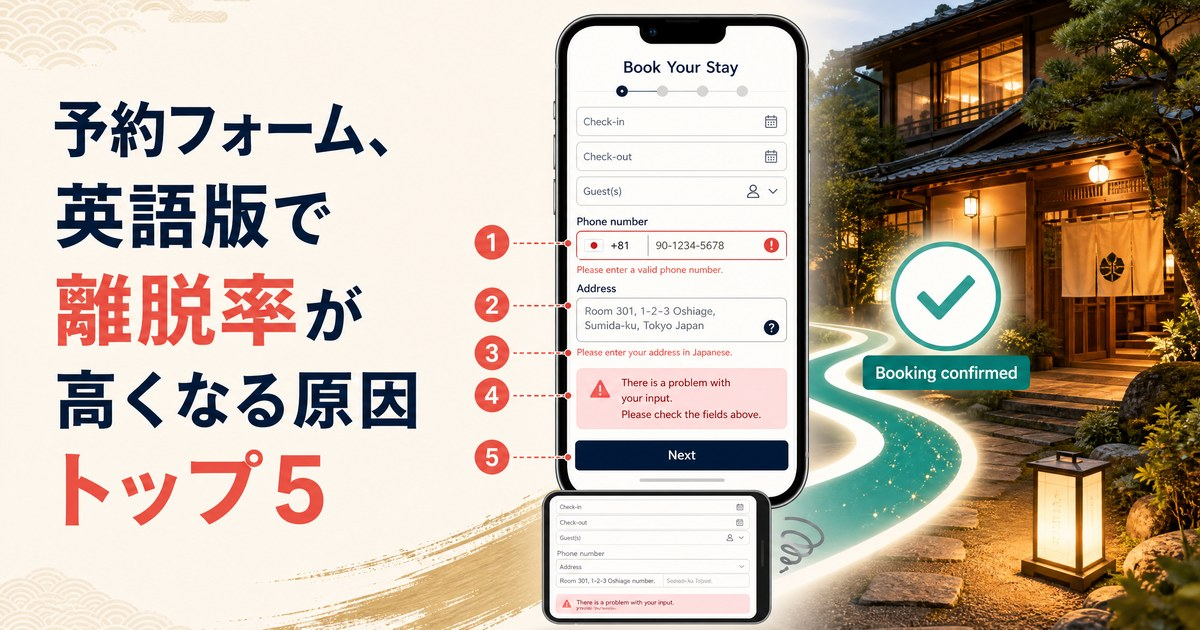
Many guests visit your site, show interest, and check rates and cancellation policies—but they abandon the reservation process at the final stage of filling out the form. This results in a significant loss of potential bookings.
The drop-off rate on reservation forms is often unrelated to the appeal of the content or the quality of translation. In this article, we will discuss five common reasons for high drop-off rates on English reservation forms.
Why is it Particularly Wasteful to Lose Guests at the Reservation Form?
Among the international guests who visit your site, only a small fraction actually proceed to the reservation form. When these valuable guests, who are willing to book, stumble at the form-filling stage, it signifies a missed opportunity to convert interest into bookings. The user experience (UX) of the form, though it may seem like a minor detail, is crucial in determining the overall effectiveness of your marketing efforts.
Reason 1: Input Fields Based on Japanese Customs
If the English reservation form is merely a direct translation of the Japanese version, it may still include fields like "Furigana," "Prefecture," and "Postal Code (7 digits)," which are confusing or irrelevant to international guests. Fields that are unnecessary for non-Japanese speakers, such as the Furigana field, should be hidden or marked as optional in the English version.
Reason 2: Address Input Format Remains Japanese
Forms that are designed based on the Japanese address format (Prefecture, City, Town, and Block) may not accommodate the varying address formats used internationally (which can differ by country, such as Street Number, Street Name, City, State, and Postal Code). If the form requires mandatory input in the Japanese format, international guests who do not have this information may be unable to fill it out and will abandon the process. Providing a free-text address field that accommodates different country formats is an effective solution.
Reason 3: Phone Number Format Errors
Validation features based on Japanese phone number formats (starting with 0, specific hyphen placements) may reject international phone numbers (which start with a country code and have varying lengths) as "errors." This is a common technical issue that often goes unnoticed. It’s essential to either allow free input that includes country codes or adjust the validation rules to accommodate international phone number formats.
Reason 4: Error Messages in Japanese or Unclear
When there are issues with the input, if error messages are displayed in Japanese or simply state "Error" without clarity, guests will be unable to correct their entries and may abandon the form. It’s crucial to specify which fields have errors and provide clear instructions in English on how to correct them.
Improvement Example: "Please enter a valid phone number, including your country code (e.g., +1 for the US)."
Reason 5: Display Issues on Mobile Devices
English text tends to be longer than Japanese, and using a form layout designed for Japanese may result in buttons being cut off or input fields being too small. Since many international guests consider reservations via smartphones, it’s essential to check the mobile display of the English version separately from the Japanese version.
Checklist: Things You Can Check Right Now
- Ensure that unnecessary fields for non-Japanese speakers, such as Furigana, are not present in the English version.
- Confirm that the address field can accommodate international address formats with a free-text option.
- Verify that phone number input validation accommodates formats including country codes.
- Ensure all error messages are in English and provide specific correction instructions.
- Open the English version of the form on a smartphone to check for layout issues.
Related Factors to Consider for Drop-off
In addition to the reservation form itself, insufficient explanations of payment methods (Credit Card Payment and Payment Method Pitfalls in English) and vague cancellation policies (The Importance of Clear Cancellation Policies in English) can also lead to drop-offs just before booking. We recommend reviewing these pages alongside improving the form.
Conclusion: Don’t Let Guests Stumble at the Final Step
The reservation form is the "final barrier" in the customer acquisition process. Small hurdles at this stage can waste all the marketing efforts made up to this point. It’s advisable to not only review the design and text but also to have someone from a foreign perspective (ideally an international guest or a native English speaker) fill out the form completely to identify any stumbling points.
Studio HAKO's HAKO Scan offers a free diagnosis of the international compatibility of your reservation process, including the reservation form. Start by assessing your current situation.