
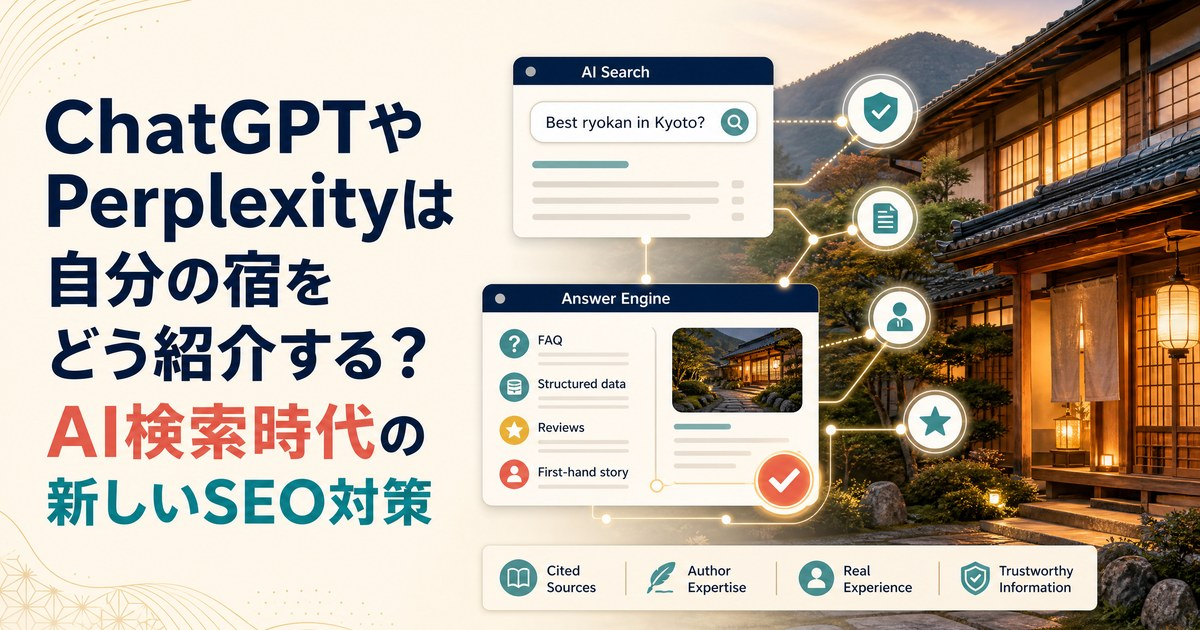
As international travelers increasingly turn to AI search tools like ChatGPT and Perplexity, they are asking questions such as "What are the recommended ryokans in Kyoto?" or "Can you suggest family-friendly onsen accommodations?" The likelihood of AI recommending your ryokan is not solely determined by traditional SEO strategies. In this article, we will explore a new optimization approach for the AI search era—AEO (Answer Engine Optimization).
What is AEO?
AEO refers to efforts aimed at ensuring that your content is easily cited or referenced as part of the answers provided by AI in response to user inquiries. While traditional SEO focuses on achieving high rankings in search results, AEO aims for your information to be utilized as a source when AI generates responses.
According to Google's official stance (as of May 2026), AIO and AEO are not separate initiatives but rather extensions of SEO efforts. There is no need to write specifically for AI; the foundational principles of SEO (clear information structure and reliable content) also serve as the basis for AEO.
Three Conditions for Being Included in AI Responses
Based on current knowledge, the following three conditions make it easier for AI to incorporate your information into its answers:
- Is the structure designed to answer questions directly? (Clear correspondence between questions and answers)
- Is the writing easy for machines to understand? (Correspondence between headings and content, implementation of structured data, etc.)
- Is there reliable evidence (E-E-A-T)? (Information based on real experiences, expertise, authority, and trustworthiness)
Specific Actions Ryokan Websites Can Take Now
1. Write FAQ with a Conclusion-First Approach
Presenting a concise conclusion immediately after the heading (question) is a format that is more likely to be cited by AI search engines. The structure of "How to Create Reassuring English FAQs"—conclusion → reason → next action—is effective for AEO as well.
2. Implement Structured Data (Schema.org)
By marking up accommodation information (address, rates, amenities, etc.) as structured data, search engines and AI can more accurately read the content of your pages. This requires specialized implementation, so it’s crucial to keep this in mind when working with production companies or developers.
3. Incorporate Primary Information and On-Site Experiences
Particularly valued in the AI context is primary information (information based on real experiences). Content based on the words of the innkeeper or staff, seasonal stories from actual experiences, and unique backgrounds that cannot be found elsewhere are increasingly valuable in the AI search era. Content that conveys the meaning of experiences, as discussed in “How to Create English Content Delivering Traditional Cultural Experiences (Tea Ceremony, Kimono, etc.),” is effective in this regard.
4. Increase External Evaluations and Mentions
While optimizing your own website can lead to results, AI tools like ChatGPT and Gemini tend to build responses based on evaluations and mentions from external media (review sites, travel media, etc.). This means that enhancing your presence on platforms like TripAdvisor and Google reviews, as well as being featured in travel media, becomes more important than ever in the AI search era. The approach to utilizing reviews is discussed in “How to Leverage TripAdvisor and Google Reviews for International SEO.”
5. Increase Branded Searches (Brand Recognition)
In response to vague questions like "recommended accommodations," AI tends to prioritize well-known large facilities. However, when asked specifically about your ryokan, such as "Tell me more about (ryokan name)," AI must handle your information. Increasing brand recognition through social media and newsletters to boost branded searches is considered an effective strategy in the AI era.
Important Note: Understand That This is an Evolving Field
AEO is a relatively new concept, and the logic behind AI responses varies by service and is expected to continue evolving. There is no established method that guarantees your ryokan will be mentioned, so it is essential to maintain the foundational principles of SEO and content (clarity, reliability, and continuous updates). These efforts will ultimately serve as effective strategies from an AEO perspective.
Conclusion: Building on Basics Leads to Effective Strategies in the AI Era
When considering strategies for the AI search era, it may seem that special technical measures are required. However, the foundational practices discussed in this blog—enhancing FAQs, responding to reviews, and creating content that includes primary information—serve as the foundation for AEO strategies. Gradually incorporating checks on visibility in AI searches into the continuous improvement cycle discussed in “The Monthly Improvement Cycle for International Marketing” is advisable.
Studio HAKO's HAKO Scan offers a free diagnosis of your readiness for international search optimization. Start by assessing your current situation.